
In the heart of Ljubljana, where the city’s pulsating modernity meets its rich historical tapestry, lies an architectural marvel that not only stands as a functional structure but also symbolizes the fusion of diverse eras and influences. This is the famed Triple Bridge (Tromostovje), a unique ensemble of three bridges that span the serene waters of the Ljubljanica river, connecting the quaint medieval town on one bank with the contemporary vibrancy of modern Ljubljana on the other.
The narrative of the Triple Bridge is a chronicle of transformation, echoing changes that have swept through the core of Ljubljana itself. Tracing its roots back to 1280, the site was originally adorned by a humble wooden bridge, historically referred to as the Old Bridge and later known as the Lower Bridge. It served as a silent witness to the countless life stories that unfolded in the city, surviving until it succumbed to a fire and was subsequently rebuilt in 1657.
The bridge underwent a significant metamorphosis in 1842, redesigned by the Italian architect Giovanni Picco. This iteration, constructed with two arches and adorned with a metal fence, was a tribute to Archduke Franz Karl of Austria, garnering the name Franz’s Bridge. This structure, however, was not just a crossing; it was a testament to the harmonious coexistence of utility and aesthetic grace, embodying the spirit of Ljubljana.
Yet, the true masterpiece was still to come. Enter Jože Plečnik, the visionary architect who perceived the old bridge’s bottleneck flaws as an opportunity for architectural poetry. Plečnik’s ambitious renovation in the early 20th century transformed the solitary Franz’s Bridge into the stunning Triple Bridge, adding two pedestrian footbridges on either side of the central structure.
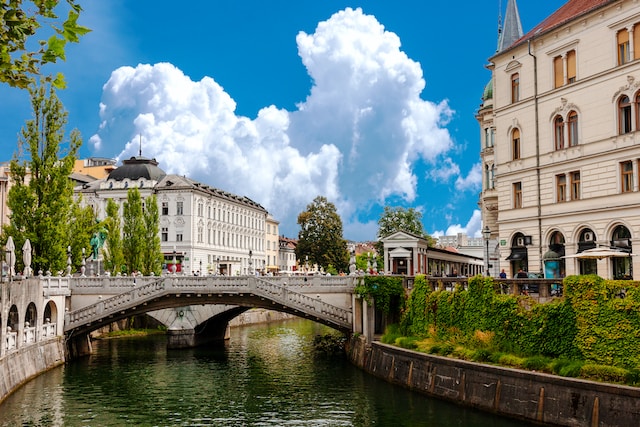
In an inspired move, Plečnik diverged from traditional design norms; the footbridges were not laid parallel to the central bridge. Instead, they spanned out in a funnel shape, a deliberate broadening that guided the urban space of Prešeren Square (Prešernov trg) across the river toward the Town Square (Mestni trg). This unique layout was more than a feat of engineering; it was a symbolic embrace, uniting the two riverbanks and making Prešeren Square the indisputable focal point of the city.
One cannot discuss the Triple Bridge without marveling at Plečnik’s Venetian influence. The architect, determined to infuse Ljubljana with the Mediterranean essence, introduced staircases leading from the pedestrian bridges to the river’s lower terrace. These staircases, reminiscent of the iconic bridges of Venice, created what could be considered a river portal, underscoring Ljubljana’s connection to other historical European centers.
The materials used in the bridge’s construction also narrate a story of evolving times. The central bridge, partially crafted from Glinica limestone, stands in contrast to the artificial concrete balustrades, featuring 642 balusters, and the platform’s granite blocks, added in 2010 to replace the former asphalt covering. These elements blend historical craftsmanship with modern practicality.
Today, the Triple Bridge, having undergone a meticulous renovation in 1992, is an exclusive pedestrian zone since 2007, buzzing with locals and tourists alike. The rhythmic alternation of the balustrades, combined with the spherical orbs of the lamps, instills a sense of perpetual motion, echoing the lively atmosphere of Ljubljana itself.
The Triple Bridge is more than a crossing or a convenient link between the historical and modern facets of the city. It is a monument to innovation, a homage to heritage, and a living, breathing piece of art that embodies the soul of Ljubljana. Whether you’re a citizen, a history enthusiast, an admirer of architecture, or a traveler, the bridge stands as a testament to the idea that practical structures can be transcendental, inspiring awe and reverence in everyone who crosses it.