
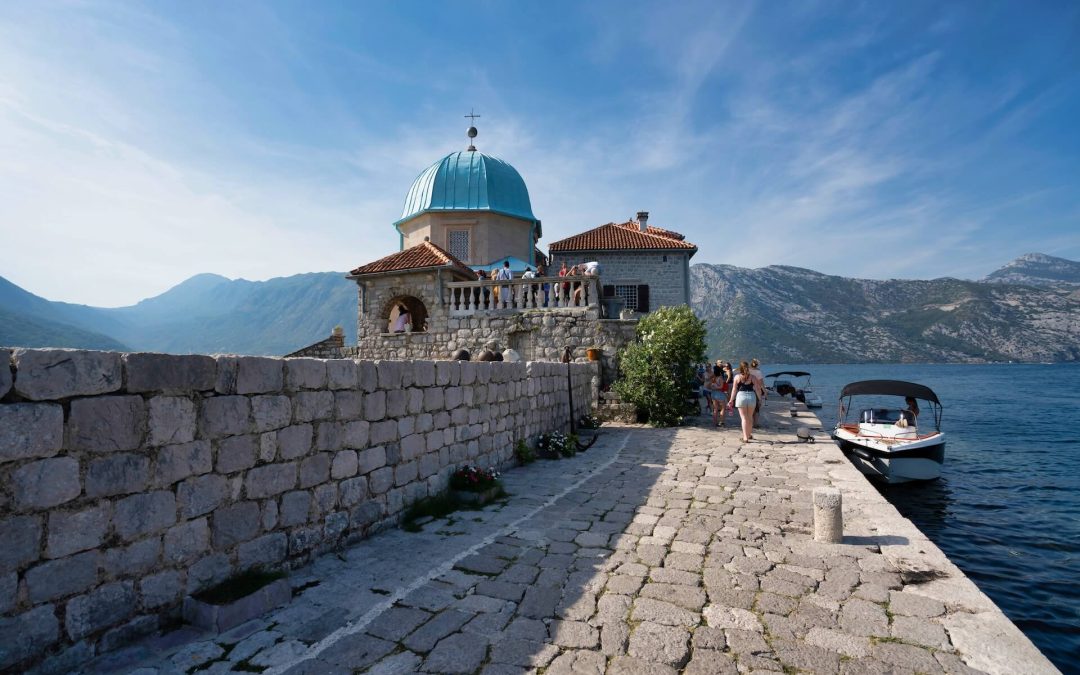
Nestled in the azure waters of the Adriatic, just off the coast of Perast in Montenegro’s breathtaking Bay of Kotor, lies an islet shrouded in legend and bound by faith: Our Lady of the Rocks. Unlike its natural neighboring islet, Sveti Đorđe, Our Lady of the Rocks presents an extraordinary narrative, having been fashioned across the ages not by the capricious whims of geology, but by the devout hands of generations of local seamen.
The genesis of this artificial island is as poetic as it is unique. It began on a fateful day on July 22, 1452, when, according to legend, sailors discovered an icon of Madonna and Child perched upon a rock adrift in the sea. This venerable find was interpreted as a divine signal, and it incited a solemn oath amongst the sailors. They vowed that upon returning from each successful voyage henceforth, they would lay a rock in the bay to commemorate their safe returns and pay homage to the Virgin Mary.
This tradition birthed an islet that, through collective effort and unyielding faith, gradually emerged from the sea—a stone testament to the sailors’ reverence and gratitude. The custom persists to this day in the annual event known as “fašinada.” As the sun dips below the horizon every July 22, the sea is peppered with boats as local residents and descendants of those original seafarers continue to lay rocks in the water, contributing to the legacy and physical expanse of the island.
Dominating the islet’s landscape is the Roman Catholic Church of Our Lady of the Rocks, its largest and most iconic edifice. Constructed upon the bulwark of rocks and sunken vessels, the church has undergone transformations since its initial establishment, with the most significant renovation occurring in 1722. It now stands not only as a place of worship but also as a trove of cultural and artistic heritage.
The interior of the church is a homage to artistic devotion and spiritual expression, most notable for housing 68 paintings by Tripo Kokolja, a revered Baroque artist from the local town of Perast. Among these artworks, “The Death of the Virgin,” spanning an impressive ten meters, holds particular prominence. Alongside Kokolja’s masterpieces are works by Italian artists and a cherished icon of Our Lady of the Rocks, crafted by Lovro Dobričević of Kotor around the time of the islet’s legendary inception.
However, perhaps the most heart-rending piece within the church is not a painting but a tapestry—the labor of love of Jacinta Kunić-Mijović from Perast. Wrought over 25 years as she awaited the return of her beloved from his travels, this intricate tapestry was crafted using silver and gold fibers. Tragically, the work cost Kunić-Mijović her eyesight. The tapestry is renowned not just for its beauty or the sad romance that inspired it, but for the strands of Jacinta’s own hair that are interwoven within, immortalizing her personal sacrifice and devotion.
Our Lady of the Rocks stands as a monument to many forms of dedication: the religious commitment of the seamen who shaped it, the artistic devotion encapsulated within its walls, and the unyielding affection of a woman for her seafaring sweetheart. It is more than a mere islet in the Bay of Kotor; it is a storied chapter of Montenegrin history, a lasting symbol of faith, and a living testament to the human capacity for creating enduring beauty, whether through shaping the very land from the sea or through the intimate artistry of the human hand.